Rule or Be Ruled (Sovereignty > Slavery)
Jan 09, 2026"You can't blame anyone else for what you have or don't have. You have to take responsibility." — Tom Brady
“He who observes the wind will not sow, and he who regards the clouds will not reap.” — Ecclesiastes 11:4
In the late 19th century, the steel industry was a chaotic gamble. Prices were wildly volatile, caught up in a storm of changing tariffs, global trade, and economic crashes.
Most steel tycoons were obsessed with the market price. When prices were high, they celebrated. When prices dropped, they panicked, tried to form cartels to fix rates, or lobbied the government for protection. They were slaves to the market—their success depended entirely on external factors they couldn't control.
Andrew Carnegie played a different game.
While his competitors wasted energy worrying about the price of steel (which they couldn't control), Carnegie ruthlessly focused on the cost of making steel (which he could control).
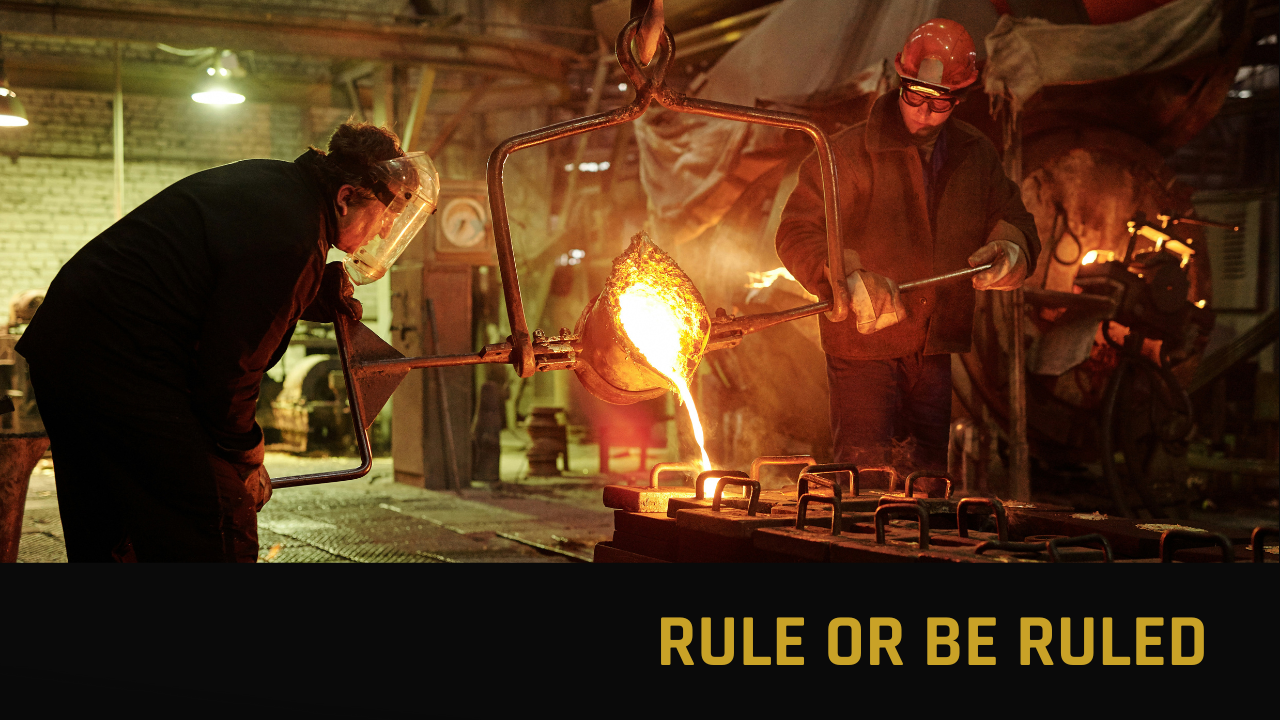
He installed modern blast furnaces, tracked every ounce of raw material, and engineered systems to shave fractions of a penny off production. His motto was simple:
"Watch the costs, and the profits will take care of themselves."
When the market inevitably crashed, his competitors—who were leveraged and inefficient—went bankrupt. Carnegie remained profitable even at rock-bottom prices. How? By refusing to play the market’s game. He didn't just survive the crash; he bought his bankrupt competitors for pennies on the dollar.
Carnegie refused to give energy to variables he couldn't influence. He was the Sovereign of his own ledger.
Most modern leaders are doing the exact opposite.
Most leaders believe they are the Ruler of their business. They signed the incorporation papers. They hold the title. They sign the checks.
But if you look at their calendar, their stress levels, and their ability to leave the office, they don't look like Sovereign Leaders. They look like indentured servants.
They are constantly reacting to client demands, employee issues, and market shifts. They are exhausted, anxious, and overwhelmed. They built a castle, but they are scrubbing the floors.
I work with leaders who tell me, “I’m no longer operating as an owner; I’m just the most expensive employee in my business and I’m managed by my broken systems.”
Sound familiar? If so, here’s a reality check: You aren't a bad leader. You are just trapped by bad systems.
To fix them, you must first define your relationship with your business. You either own it, or it owns you. This is the second Core Commitment: Sovereignty > Slavery.
What is Sovereignty and Slavery?
SOVEREIGNTY is the radical acceptance of total responsibility for your business, your inputs, and your outcomes.
Sovereignty is not the anxiety of trying to control the uncontrollable (like the market, the economy, or the weather). Instead, it is the ruthless discipline of mastering the variables you can control—your calendar, capital, and your culture.
Sovereignty is the aggressive decision to rule your circumstances rather than resent them.
SLAVERY is the seductive comfort of assigning blame to forces outside your control.
Slavery is not defined by how hard you work or how many hours you log (you can be a Sovereign hustler). Instead, it is defined by the belief that you are a victim of your employees, your clients, or the algorithm.
Slavery is the passive decision to let your business happen to you.
A Personal Confession
I learned this the hard way during a massive expansion project I led years ago.
I hired a guy for one of our key locations who was incredible on paper. In a one-on-one setting, he was world-class—empathetic, engaging, and deeply relational. I thought I had found a unicorn.
But the job wasn't just about one-on-one connection; it required commanding a room of hundreds of people.
The reality was brutal. He didn't just lack charisma; he actively sucked the energy out of the room. The disconnect was painful to watch.
Here is where the "Slavery Mindset" kicked in.
Instead of fixing the problem, I blamed him. I told myself:
- "He isn't trying hard enough."
- “He doesn’t see what’s really happening.”
- "He doesn't respect my feedback because I'm younger than him.”
I spent months trying to "coach" him into being high-energy. I gave him tips, scripts, and feedback. Nothing worked. I felt frustrated, victimized, and annoyed that my "star hire" was failing me.
Then, I looked in the mirror. I was blaming a person for a process I created.
I realized I was trying to teach a shortstop how to be a pitcher. The problem wasn't his effort; the problem was my selection.
He wasn't a bad leader; he was just in the wrong seat.
I wasn't a victim; I was the architect of the failure.
I had hired a counselor to be an emcee. That wasn't his fault; it was mine.
The moment I accepted Sovereignty over that decision, the frustration vanished. I stopped blaming him for being who he was, moved him to a role that leveraged his actual strengths, and hired someone else who was built for the stage.
Slavery looks out and asks: "Why won't he change?" Sovereignty looks in and asks: "Why did I put him there?"
The Spectator Trap
We see this "Slavery Mindset" everywhere in modern life. Look at the sports fanatic.
He sits on the couch, 40 pounds overweight, screaming at the television because a professional athlete missed a pass. He criticizes the coaching strategy, the referee calls, and the player effort.
He has zero skin in the game. He isn't sweating. He isn't risking injury. He is a spectator (and he’s not even on the sideline!). He chooses the safety of criticism over the risk of participation.
This is fine when it comes to your entertainment. But for your business, it is deadly.
Slavery is the seat of all excuses. It allows you to wrap yourself in a warm blanket of "Woe is me" so you never have to do the sobering, hard work of "I need to work on me."
You cannot be a spectator in your own company. You cannot sit in the CEO chair and complain about the culture you built. You cannot complain about the leads that aren't falling into your lap.
The Sovereign Leader gets off the couch and into the game.
The Anxiety of Over Control
There is a misconception that Sovereignty means "controlling everything." That is impossible. Trying to control every variable—what the Fed does, what a client thinks, what a competitor launches—is not Sovereignty. It is insanity.
When you try to control the uncontrollable, you don't end up with more control. You get anxiety.
Sovereignty is the discipline of knowing the difference:
- The Slave worries about the rain.
- The Sovereign builds a roof (and then sells the space under the roof).
The Slave waits for the "market to turn." The Sovereign looks at the board, assesses the pieces, and makes the move.
- The Slave chooses anxiety because they are focused on the outcome (which they can't control).
- The Sovereign chooses action because they are focused on the input (which they can control).
Here is the dark truth: Over-control is just another form of slavery.
Many leaders believe that if they just stress enough, they moving the needle. They become addicted to the panic. The anxiety becomes familiar—even comfortable—because it convinces them they are "working hard."
What’s your next move? Anxiety or action?
Growth vs. Maintenance
This distinction determines the trajectory of your business.
Sovereignty is a Growth Mindset. The goal of the Sovereign is to maximize potential. Build the system. Break the bottleneck. Engineer the solution. The Sovereign asks, "How do I make this better?"
Slavery is a Maintenance Mindset. The goal of the Slave is to minimize risk. Keep the head down. Don't rock the boat. Avoid pain. The Slave asks, "How do I keep this from falling apart?"
- The Fire: If you are running around putting out fires to save the day, you are a slave to the chaos. If you are installing a sprinkler system so the fires never happen again, you are the Sovereign of your operation.
- The Cash: If you are discounting your prices just to close a deal and make payroll, you are a slave to desperation. If you are building a marketing engine that generates qualified leads while you sleep, you are the Sovereign of your value.
- The People: If you ignore a toxic employee because you are afraid of the conflict, you are a slave to comfort. If you have the hard conversation to protect the standard of the team, you are the Sovereign of your culture.
The Connection: Truth Before Sovereignty
You cannot commit to Sovereignty until you have committed to Truth. Why? Because you cannot take responsibility for a problem you refuse to see.
- If you have Truth without Sovereignty, you are just a well-informed victim. You know exactly what’s wrong, but you lack the will to fix it.
- If you have Sovereignty without Truth, you are a dangerous gambler. You are taking massive risks based on Ego, not data.
Sovereignty + Truth = Strategic Momentum.
- Truth gives you the map. It shows you where the systems are broken.
- Sovereignty gives you the steering wheel. It gives you the agency to control your car.
How to Practice Sovereignty
Sovereignty is not a title you inherit. It is a muscle you build. It is the refusal to outsource the state of your life or business to external factors.
Here is how to flex it:
1. The "They" Audit
Listen to your own language for one week. Every time you say "They" (e.g., "They didn't get it done," "They changed the rules"), stop. Replace "They" with "I."
- Slave: "They didn't send the report."
- Sovereign: "I didn't build a system that ensures the report is sent."
2. Define Your Sphere of Control
Draw a circle on a piece of paper. Inside, write what you control (Your effort, your systems, your reactions, etc). Outside, write what you don't (Client mood, economy, competitors, etc.).
If you find yourself stressing about anything outside the circle, you have slipped back into Slavery. Stop. Move back inside the circle.
3. Move from "Spectator" to "Architect"
When a problem arises, Spectators commentate ("Wow, that's a mess"). Architects design ("We need a new support beam here"). Never point out a problem without bringing a blueprint for the solution.
Before We Move On
The commitment to Sovereignty > Slavery is a commitment to radical responsibility.
It requires you to give up your two favorite security blankets: Blame (it's their fault) and Victimhood (it's happening to me).
Slavery is comfortable because it demands nothing of you but endurance. Sovereignty is difficult because it demands that you build.
Ultimately, choosing Sovereignty means choosing a Growth Mindset. It means embracing calculated risks instead of avoiding them at all costs.
You can be safe in your slavery, or you can be free in your Sovereignty. You cannot be both.
Stop waiting. Start building.
Find out what’s really running your business — you or your systems.
Build Systems That Serve Your Mission.
Get one practical, no-fluff insight each week from The Systems Sovereignty Playbook — helping Builders who’ve outgrown their hustle reclaim clarity, control, and capacity.